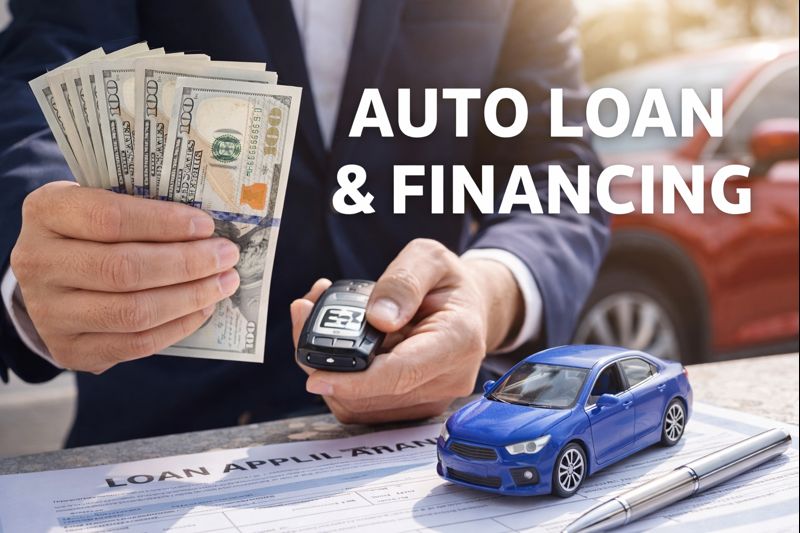
Looking for auto financing near me means finding lenders that match your credit profile, budget, and timeline—local banks, national lenders, dealership finance departments, and online lenders all compete for your business. You can compare auto financing rates and terms quickly by checking local banks, dealership offers, and online lenders to find the lowest total cost and the payment schedule that fits your budget.
As you explore options, focus on monthly payment, interest rate (APR), loan term, and any fees or incentives for electric or hybrid vehicles. This article walks you through what those terms mean, how to compare offers, and how to pick the financing path that keeps your payments manageable and your options open.
Understanding Auto Financing Near Me
You’ll learn which loan types local lenders offer, what lenders check when you apply, and how to compare rates and terms at nearby banks, credit unions, and dealer finance desks.
Types of Auto Loans Available Locally
Local lenders typically offer three main loan types: secured new-car loans, secured used-car loans, and dealer-arranged financing.
Secured loans use the vehicle as collateral, so rates are usually lower. New-car loans often have promotional APRs from manufacturers or dealers you can find at local franchises. Used-car loans may carry higher rates because of vehicle age and mileage.
You may also find personal loans used for car buying; these are unsecured and can suit private sales or borrowers with limited vehicle equity. Lease buyouts and refinancing are common at larger banks and credit unions in your area.
Check term lengths (24–84 months), prepayment penalties, and whether the lender requires full insurance coverage.
How to Qualify for Local Auto Financing
Lenders in your area evaluate credit score, income, debt-to-income (DTI) ratio, employment history, and the vehicle’s value.
Aim for a credit score that matches the lender’s tier: prime (lower APRs), non-prime (higher APRs), or subprime (specialized programs). Bring recent pay stubs, bank statements, and proof of residence to speed approval.
Down payment size and trade-in value affect required financing and rate offers. A larger down payment reduces loan-to-value (LTV) and can lower interest rates. If you have limited credit, consider a co-signer or pre-qualification tools offered by local lenders to show probable terms without impacting your credit score.
Comparing Lenders in Your Area
Compare these elements: APR, loan term, total interest paid, fees, and customer service responsiveness.
Get written quotes from at least three sources: a local bank, a credit union, and the dealer’s finance office. Use a simple table to compare offers:
- APR — annual percentage rate
- Term — months to repay
- Fees — origination, documentation, prepayment
- Total cost — principal + interest + fees
Also evaluate approval speed, flexibility for early payoff, and whether the lender finances private-sales or only dealer purchases. Credit unions often offer competitive rates but membership may be required. Dealers may bundle incentives; verify that manufacturer rebates don’t vanish if you choose third-party financing.
Choosing the Right Auto Financing Option
You should compare local interest rates, loan terms, and lender fees, and gather required documents before you apply. Pay attention to total cost, monthly payment, and any prepayment or late-payment penalties.
Interest Rates and Terms in Local Markets
Shop rates from banks, credit unions, and dealer financing in your city to find the lowest APR for your credit profile. Rates vary by lender and by whether the vehicle is new or used; for example, used-car loans typically carry higher rates than new-car incentives.
Compare term lengths (36, 48, 60, 72 months). Longer terms lower monthly payments but increase total interest paid. Use a payment calculator to see how term and rate change both monthly cost and overall interest.
Watch for extra costs: origination fees, mandatory insurance requirements, and rate markups at dealerships. If you have good credit, get preapproved to lock a rate and improve negotiation leverage at the lot.
Required Documentation and Application Process
Prepare these standard documents before you visit lenders: government ID (driver’s licence or passport), proof of income (recent pay stubs or T4), proof of residence (utility bill), and recent bank statements. If self-employed, bring two years of tax returns and a Notice of Assessment.
Expect a credit check during application; know your credit score beforehand so you can predict likely rate tiers. Provide vehicle details (VIN, mileage, year, make, model) for dealer or private-sale financing.
Applications can be done online or in person. Online preapproval often takes minutes to a few days; in-person deals may close the same day if paperwork and insurance are ready. Always read the loan contract for prepayment penalties and gap insurance requirements before signing.